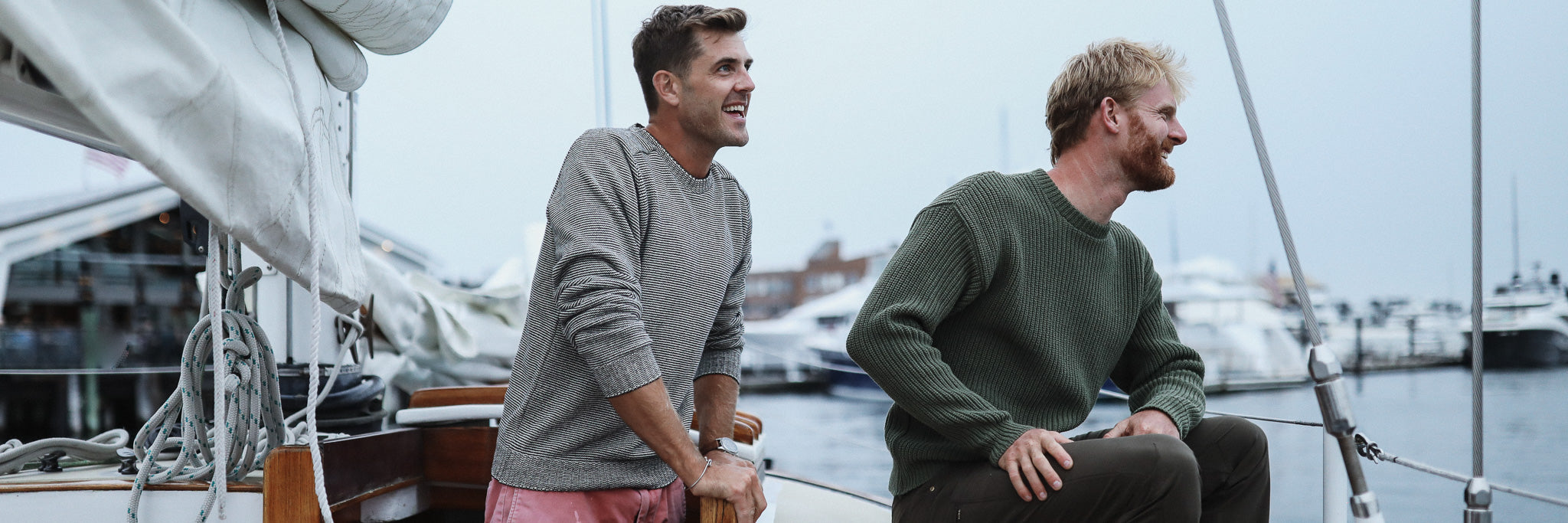

Timeless Maritime Design
A History of the Boatneck Sweater
The boatneck sweater, defined by its wide, horizontal bateau neckline, has one of the clearest functional origins in knitwear history. Long before it became a staple of modern wardrobes and fashion editorials, the wide, horizontal neckline was engineered for life at sea. Designed for sailors who worked long hours on open decks, the boatneck offered ease of movement, ventilation, and practicality in harsh maritime conditions.

The Whalerknits Boatneck in Natural / Olive
Its defining feature—a straight neckline that runs horizontally across the collarbone—was not a stylistic flourish. It allowed garments to be pulled on and off quickly, even when wet, and made it easier to remove a sweater if a sailor fell overboard. The opening was wide enough to slide over the shoulders without buttons or fastenings, reducing points of failure in salt-heavy environments.
Naval Roots and the French Navy Tradition
The boatneck sweater is most closely associated with the uniform of the French Navy. In 1858, the French Navy officially adopted the marinière—a sailor shirt defined by its navy and white horizontal stripes—as standard issue for seamen stationed along the coast of Brittany (Bretagne). The Breton refers to its stripe pattern—traditionally 21 white stripes and 20–21 blue stripes—designed to make sailors more visible if they fell overboard. The wide, shallow boatneck was an associated construction detail, chosen for function rather than fashion.

Portrait of a Young Breton Sailor by the French artist Émile Vernon. (19th Century)
Over time, while the stripe became symbolic of French naval identity, the boatneck neckline itself spread across unstriped knitwear and sweaters used by sailors, fishermen, and dockworkers throughout Europe. It became symbolic, signaling discipline, craftsmanship, and life tied to the sea.

French sailor in uniform, early 20th century
From Working Garment to Cultural Icon
As with many utilitarian garments, the boatneck sweater’s transition into civilian life followed broader social shifts. In the late 19th and early 20th centuries, coastal communities adopted naval-inspired knitwear for everyday use. Fishermen, dockworkers, and shipbuilders favored the same neckline for its comfort and durability.
By the early 20th century, the boatneck crossed from workwear into leisurewear. Seaside holidays, yachting culture, and growing fascination with nautical style introduced maritime knits to the upper classes. The clean lines of the boatneck appealed to designers and tastemakers looking for clothing that felt effortless but grounded in tradition.
The Boatneck in Fashion History
The boatneck sweater’s rise in fashion owes much to the modernist movement of the early-to-mid 20th century. Designers and artists were drawn to garments that stripped away ornamentation in favor of form and function.

Coco Chanel in the Boatneck silhouette in the 1920s
Coco Chanel famously embraced nautical silhouettes in the 1910s and 1920s, introducing boatneck tops and sweaters to women’s fashion. The neckline’s simplicity aligned perfectly with her vision of relaxed elegance, and it quickly became associated with coastal sophistication rather than labor.
Throughout the decades that followed, the boatneck remained a quiet constant. It appeared in mid-century resort wear, postwar minimalist wardrobes, and later in American sportswear. Unlike trend-driven necklines, the boatneck never felt dated—its geometry was too pure, its origins too honest.

Pablo Picasso was taken by photographer Robert Doisneau in his studio in Vallauris in 1952
Craft, Construction, and Knitwear Tradition
From a knitwear perspective, the boatneck requires precision. The neckline must sit cleanly across the shoulders without gaping or collapsing. Traditionally, this meant tightly controlled stitch tension and thoughtful shaping at the shoulders and collar.
Historically, boatneck sweaters were knit from wool chosen for resilience rather than softness. Modern interpretations may use finer merino or cotton blends, but the fundamental structure remains unchanged.
An Enduring Symbol of Maritime Style
What makes the boatneck sweater enduring is its refusal to be flashy. It doesn’t rely on embellishment, logos, or seasonal trends. Its appeal lies in proportion, balance, and heritage. It speaks to a time when clothing was designed to serve a purpose first, and beauty followed naturally.
Today, the boatneck sweater continues to anchor nautical-inspired wardrobes. It appears in men’s and women’s collections alike, often paired with denim, canvas, or tailored trousers. While materials and fits evolve, the neckline remains true to its origins.
For brands rooted in maritime tradition and American manufacturing, the boatneck sweater represents continuity—a direct line from historic seafaring garments to contemporary knitwear.
It is a reminder that the most iconic designs are rarely invented overnight. They are earned, refined, and proven over generations of real use.

The Nantucket Boatneck in Burgundy / Natural
The Whalerknits Boatneck Tradition
At Whalerknits, the boatneck sweater is not a reinterpretation—it is a continuation. Since 1975, Whalerknits has been committed to manufacturing knitwear in the United States, preserving the craftsmanship, materials, and construction methods that define authentic maritime garments.

The Nantucket Boatneck in Natural / Nantucket Red
Each Whalerknits boatneck reflects decades of experience knitting sweaters built for longevity, comfort, and understated coastal style. Two styles in particular—the Nantucket Boatneck and the Newport Boatneck—embody this heritage.
The Nantucket Boatneck Sweater
The Nantucket Boatneck is the most traditional expression of the silhouette. Inspired by classic maritime knits worn along the New England coast, it features a clean, balanced neckline and a timeless fit designed for everyday wear. And like everything else from Whalerknits, the Nantucket Boatneck is proudly American-made, built in house in Fall River, Massachusetts.

The Nantucket Boatneck in Natural / Navy
Knit with durability in mind, the Nantucket Boatneck reflects the original purpose of the design: warmth without bulk, structure without stiffness, and a neckline that sits naturally across the shoulders. It features a two color horizontal striped pattern, reminiscent of the Breton stripe. A midweight 7 gauge jersey knit, this is a versatile garment. It is a sweater meant to be worn season after season—on the water, in town, or wherever coastal life leads.

The Nantucket Boatneck in Nantucket Red / Natural
This style speaks directly to Whalerknits’ roots, combining historic form with modern consistency in American manufacturing.
The Newport Boatneck Sweater
The Newport Boatneck offers a slightly refined interpretation of the classic design, drawing inspiration from the sailing culture and understated elegance associated with Newport’s maritime history.

The Newport Shaker Boatneck is stunning in Navy. Especially on a 48' sailing yacht.
While maintaining the essential boatneck proportions, this style leverages a heavier 4 gauge, chunkier Shaker knit. The result is a sweater that is warmer while remaining breathable.

The Whalerknits Newport Boatneck in Navy
Like all Whalerknits sweaters, the Newport Boatneck is proudly made in the USA, continuing a manufacturing tradition that has defined the brand since 1975.
Together, these sweaters represent more than individual products—they are living examples of how authentic knitwear heritage endures when craftsmanship, place, and purpose remain aligned.

Whalerknits was founded in 1975 in New Bedford, Massachusetts and has made knitwear in the USA ever since. Today we continue its legacy of producing top-notch sweaters and knitwear accessories along the South Coast of Massachusetts in Fall River, as part of the Merrow Group. As always, Whalerknits are proudly designed, knit, cut and sewn in the USA.